By Miki Mullor
HIDEOUT, Utah — Facing mounting questions about whether it has enough water rights to support continued growth, the Town of Hideout commissioned a comprehensive drinking water audit intended to answer a critical question: Can the town build out under its existing approvals without running out of water?
The audit’s answer is reassuring. By lowering the assumed per-home water use and accounting for a range of existing and future sources, the report concludes that the town has sufficient supply for at least eight more years, presenting this as “confirmed.”
But a detailed review of the claim, the underlying agreements, and the audit author’s own written responses reveals a different picture.
The audit does not demonstrate that the town currently has enough legally available water rights to meet its obligations. Instead, it constructs a supply model built on assumptions: that irrigation water can be converted without acquiring replacement rights, that developer-controlled water will be delivered in the future, and that legal constraints governing water allocation do not limit how supply can be used.
In some cases, those assumptions directly conflict with governing agreements. In others, the audit’s author acknowledges the limitations outright.
Taken together, the result is a report that answers a narrower, more optimistic question — whether enough water could exist under a favorable set of conditions — while leaving unresolved whether that water is actually available to the town today.
“Confirmed” supply that depends on missing pieces
The audit’s Table 4 presents a consolidated view of water available to Hideout. The framing is clear: these are sources the town can rely on: “Currently, the Town has a JSSD confirmed supply of 605.07 acre-feet of water.”
(One acre-foot is defined by Utah’s Division of Water Rights as the volume of water required to cover one acre of land to a depth of one foot, which equals approximately 325,851 gallons. A permanent residency single-family home is considered to consume 0.45 ac/ft annually)
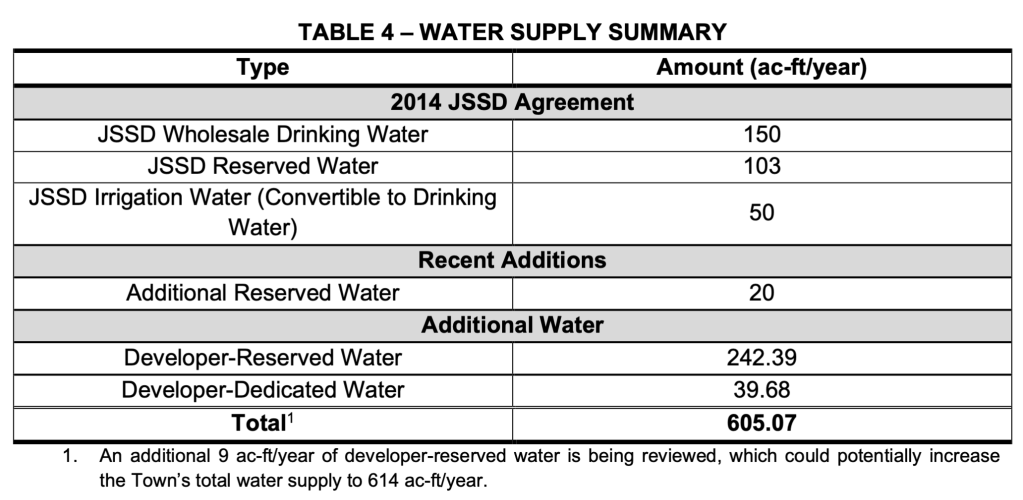
(Source: Town of Hideout Drinking Water Audit, p. 7)
Yet key components of that table, 48% of it, are contingent — and in some cases speculative.
At the center of the issue is a fundamental distinction: the difference between theoretical water availability and legally enforceable water rights.
The 50 acre-feet assumption that isn’t real supply
One of the audit’s most significant conclusions is that the town can rely on 50 acre-feet of irrigation water currently leased for golf course use and convert it into drinking water.
On paper, the audit treats the full 50 acre-feet as convertible supply. In practice, the situation is more complicated.
The governing agreement with the Jordanelle Special Service District (JSSD) does allow conversion — but only if the town transfers other water rights into the system first.
That requirement is not a technicality. It is a prerequisite.

In written responses to questions, Steven Jones, CEO of Hansen, Allen & Luce Inc, the audit’s author, acknowledged that current golf course usage was not subtracted from the 50 acre-feet. Instead, the analysis assumed that “other non-drinking water rights could potentially replace the amount the golf course is currently using,” adding that “finding a potential replacement was outside the scope of our study.”
Jones asserted that “for the past 2 years, the golf course has used about 5 ac-ft per year according to JSSD.” However, according to documents obtained by JSSD in a public records request, 5 acre-feet was recorded only once in the last five years, with a much higher usage recorded at 24.5, 20.8, 20, 9.6, and 8.4 acre-feet, which averages 14.72 acre-feet, three times the 5 acre-feet assumed in the audit.
In other words, the audit counts water that is already being used in a low outlier year — and assumes, without evidence, that it can be replaced.
The result is a “confirmed” supply that depends on water the town does not currently have.
Developer water counted before it exists
The audit also includes 242 acre-feet of “developer-reserved” water as part of the town’s future supply.
But that water is not owned by the town.
It is controlled by developers and has not yet been dedicated. Jones agreed that “until that happens… the town doesn’t actually have that supply available.”
There is also no certainty regarding how much water will ultimately be transferred or when — if ever — that transfer will occur.
Even more significantly, the audit proposes reducing the town’s level of service (LOS) — the amount of water required per home — by 20 percent. Because Hideout contends that developer dedication obligations are tied to that LOS, the same reduction would apply to future transfers.
Jones confirmed that effect directly: the 242 acre-feet assumption would drop to approximately 193 acre-feet under the audit’s own methodology.
That creates a double discount: water that is not yet available is first counted in full, then implicitly reduced, with no clear accounting of how or when it would materialize.
A legal gap the audit declines to address
The audit frames its conclusions around system capacity — whether there is enough water in aggregate to serve projected demand.
But it explicitly sidesteps a central legal question: whether the town can issue building permits without securing water rights for each lot, as required under its development agreements.
The 2010 Master Development Agreement (MDA) between Hideout and Mustang Development ties development rights to obligations to dedicate water rights.
That structure is foundational: water rights are not simply a shared pool but a condition tied to specific development.
Yet when asked about conflicts between reservation agreements and the audit’s assumptions — including restrictions on transferring reserved water — the engineer responded: “We are not attorneys and didn’t try to interpret agreements.”
Despite that disclaimer, the audit proceeds as if those legal constraints do not limit the allocation of water.
In one response, the author stated that once water rights are provided to JSSD, they become part of a shared system and can be used to serve all customers — effectively treating dedicated rights as fungible system capacity.
That position may reflect how infrastructure operates. But it conflicts with contractual provisions that govern how water rights are transferred, reserved, and used.
Retroactive changes that may not be allowed
Another key pillar of the audit is the proposed reduction in level of service.
Lowering LOS reduces the amount of water required per home, allowing the town to claim that existing supplies can serve more units.
The audit applies this reduction across the entire system — including homes and lots already approved under higher requirements.
When asked whether such retroactive application has been formally done in Utah, the author responded broadly that the approach is used in impact fee analyses and is “Utah law.”
But the audit does not reconcile that position with the MDA, which governs vested development rights and ties water requirements to approved entitlements.
If water rights were required at a specific level when lots were approved, reducing that requirement after the fact raises legal questions that the audit does not analyze, but claims is legal: “This is Utah law and has been extensively reviewed for Hideout and efforts for many of our other clients,” said Jones. The audit does not provide any details of such legal analysis. The Comment did not try to request such analysis as Hideout proved stubbornly resistant to providing public records. For this story, the Comment relied on records provided by JSSD as Hideout demanded hundreds of dollars to produce the seven or so agreements that govern the purported water supply
LOS assumptions that understate demand
The audit’s reliance on a reduced level of service introduces another inconsistency — this time on the demand side.
The analysis appears to assume a current consumption standard of approximately 0.45 acre-feet per unit, which underpins its system-wide projections.
But the governing Master Development Agreement establishes a higher standard — 0.75 acre-feet per lot for parcels larger than 0.20 acres.
The audit does not appear to reconcile that discrepancy.
This matters for two reasons.
First, applying a lower consumption assumption than what is contractually required understates total demand. If a meaningful portion of Hideout’s remaining inventory includes larger lots, the audit’s forecast could materially undercount required water.
Second, the report does not distinguish consumption by lot size, even though water demand varies significantly between smaller and larger parcels. Hideout’s development is currently weighted toward smaller lots, but the remaining inventory includes a mix of sizes.
By using a single, reduced LOS assumption across the system, the audit effectively smooths over those differences. That approach may simplify modeling, but it obscures whether the projected demand accurately reflects the town’s actual development pattern.
In practical terms, this creates another layer of optimism:
- It assumes a lower per-home water requirement than what may be required under existing agreements
- It does not test how demand changes if larger-lot standards are applied where required
- It does not account for how the mix of lot sizes affects total system demand
Even under favorable assumptions, a deficit remains
Perhaps most strikingly, the audit’s own conclusions acknowledge that even after applying reduced water use assumptions, the system remains in deficit.
That admission underscores the broader issue: even the audit’s optimistic framework does not fully close the gap.
Reservations are not rights
Underlying much of the confusion is a technical but critical distinction: water reservations are not the same as water rights.
Reservation agreements, such as those held by developers, represent future entitlements that must still be converted and dedicated before they become usable municipal supply.
Internal ledgers further show that large volumes of water remain in “reserved” status and have not yet been allocated or dedicated to the town’s system.
Treating those reservations as present-day supply inflates the apparent availability of water.
A system built on assumptions
Taken together, the audit relies on a chain of assumptions:
- That irrigation water can be converted without first acquiring replacement rights
- That developer-controlled water will be dedicated in full and on time
- That legal constraints on water transfers do not limit allocation
- That water use requirements can be reduced retroactively
- That system-wide capacity can substitute for lot-specific water rights
- That a lower LOS accurately reflects both contractual requirements and the actual lot mix
In isolation, each assumption might be defensible as a planning scenario.
Combined, they create a projection labeled “confirmed” that depends on multiple uncertain — and in some cases contradictory — conditions.
The bottom line
The audit succeeds in answering a narrow question: whether, under a set of favorable assumptions, Hideout’s water system could theoretically serve future demand.
But it does not resolve the more important one: whether the town actually has — or will have — the legally enforceable water rights required to support that growth.
Even the audit’s author acknowledges key limitations, from missing data to unverified legal assumptions.
For residents and policymakers, the implication is clear.
The issue is not whether water can be modeled on paper as “confirmed.”
It is whether that water exists in a legally secured, transferable, and dedicated form before the next building permit is issued.
 The Hideout Comment