After the Hideout Comment exposed in our last story another misrepresentation by Mayor Phil Rubin to the town council, his administration trips over itself in attempts to save his credibility.
In the process, the administration alluded to potentially even a bigger problem looming over Hideout: the approval of development without acquiring water rights, a problem that could prove very costly, to the tune of $13-25 million potentially.
Lack of transparency by the administration and Rubin leaves much of the issues in the dark, including the financial viability of Hideout moving forward.
Town’s changing story on water rate hike
In the fallout of our previous story over Rubin’s proposed 45% water rate hike, Town Administrator Jan McCosh attempted to explain Rubin’s misrepresentation to the town council.
As we reported, Rubin brought to vote a 45% hike in water rates because, he claimed, Jordanelle Special Service District (“JSSD”), the town’s water supplier has raised their rates as evident on their website.
In an email statement, McCosh conceded partially: “you are correct the rate increase is not on JSSD’s website, though wholesale rates have been in the past and we relied on this information to make our last increase.”
But once we pressed for more accurate information on how the administration justifies the rate increase, McCosh changed her story again: “we apparently were relying on an intention of raising rates as was indicated by JSSD…. Given we begin our budget process each year before JSSD rates are finalized, the budget committee relied on a verbal assertion by JSSD of an increase.”
When asked who at JSSD gave this purported verbal assertion and when, McCosh responded with “no comment”.
In a final twist to the story, three redirections away from Rubin’s misrepresentation to the council, McCosh now claims a third party study is what directed the budget committee to increase water rates:
“The analysis of our water rates is being handled by Zions Municipal Finance (“ZMF”)… so while the budget committee has been directed by ZMF, we don’t have the analytical documents in town hall. We began the rate study with ZMF over a year ago and that rate study will be available at our public hearing in August.”
McCosh did not deny Rubin misrepresented to the council the reason behind his proposed water rate hike. The Town indeed acknowledged Rubin’s misrepresentation and published a correction on July 25, admitting Rubin’s “misstatement” and blaming it on “outdated information”. But Rubin more than “misstated”, he put a rate hike based on “outdated” information for a vote. It was only the council’s hesitation that prevented the rate hike from taking effect.
Rate hike – a system capacity issue?
In its reasoning for the water rate hike, McCosh revealed another issue – related to capacity of the water system:
“The town maintains its own infrastructure. Unfortunately, that infrastructure has capacity issues and requires significant improvements and capacity changes. We’re working on adding a lift station and getting our facilities working for long-term viability. Those costs are considered in utility rate increases.”
But a review of the Town’s 2020 Capital Improvements Plan, make it clear that the system itself doesn’t need more capacity and any future development will have to pay for their own:
“The culinary water infrastructure has been constructed to meet projected future needs while maintaining Hideout’s current LOS [Level of Service]… New delivery lines and connections are anticipated to be financed and constructed by developers of individual subdivisions… The City is currently planning on meeting the demands of future growth with its current culinary water system. No secondary system is planned at this time…”
Then why is McCosh saying that “in our ongoing efforts of health, safety and public welfare, we have been working with our municipal experts as well as special legal counsel to get our water rates appropriate for the ongoing growth and maintenance of the town’s water system”? (emphasis added)
The answer might be insufficient water rights for the already approved developments.
Council learns there is problem – over a year ago
On June 9, 2022, the Town Council heard from Ted Barnes, a legal expert on water rights who was hired to handle contract issues with JSSD.
Barnes told the council that under his current calculus, “you will have a deficit on build out. You’re going to need to work on your water supply.” In other words, the town had sufficient supply for existing residents but only for some, not for all the landowners in the developments the town approved.
The Town is under contract to buy water supply from JSSD. Barnes explained that the Town needs to have enough water rights recognized by JSSD under the contract to be able to supply water to residents.
In Utah, all water supply is regulated by the state. Each user of water must have a right to use the water. A water right can be sold and bought just like real estate. Just like land is measured in acres, water rights are measured in acre-feet, a measure that is roughly equivalent to 326,000 gallons. JSSD’s presumption is that a residential home consumes between 10,000 and 15,000 gallons per month. The state and municipalities have standards of home much water each residential unit must have a right to. The minimum is 0.45 acre-feet. Hideout currently requires 0.90 acre-feet.
Barnes told the council that to close the deficit the town must either purchase water rights on the free market, change its standard of water usage (as to require less water per home), and make developers bring their own water rights if they wish to subdivide a lot.
Barnes estimated a water right can cost $25,000 on the open market: “ [water] shares are not cheap. the current rate is somewhere in the $25,000 per acre foot but you know 10 years from now with 2,300 units built out we’re going to have a problem so we’ve got to figure it out”.
Town approves development with no water rights
However, a review of the Master Development Agreement (“MDA”) between Mustang Development LLC, the master developer of Hideout, and the town, reveals that the deficit may already exist now. Indeed, when asked by a council member to the extent of the deficit in the June 2022 meeting, Rubin evaded a straight answer but said that “shortfall is in the existing or pre-existing hideout area.”
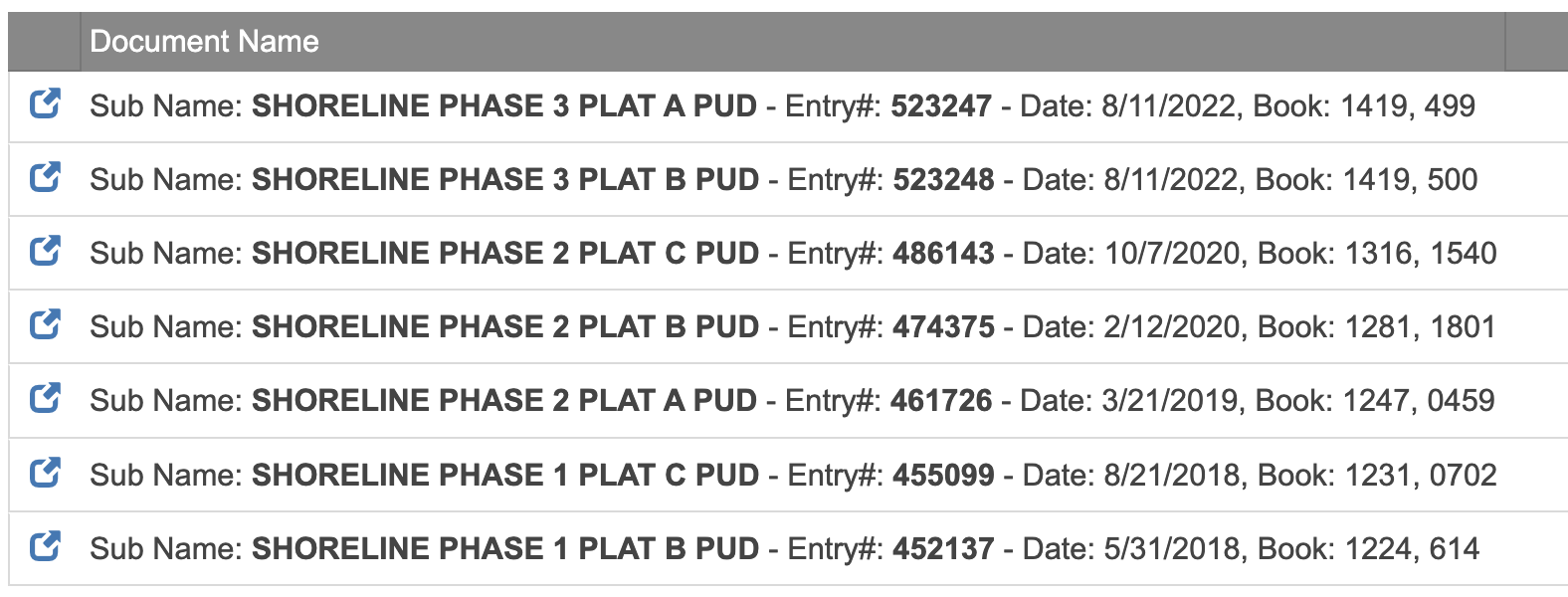
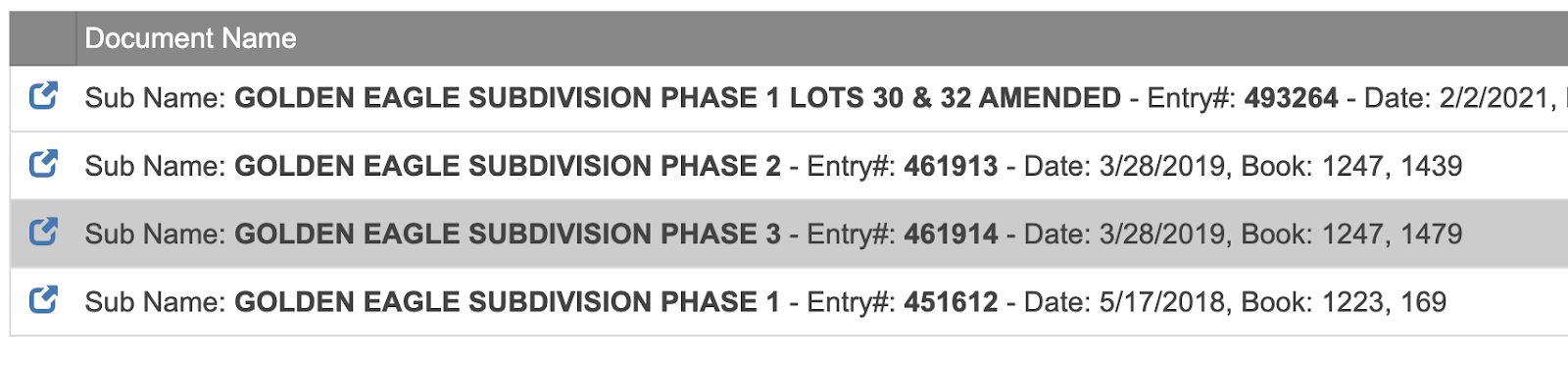
The MDA, which covers Shoreline and Golden Eagle to name a few, states very clearly that the developer must dedicate water rights to the town when a subdivision plat is recorded, unless the town already has sufficient existing water rights to serve the development.
According to the MDA, once the Town approved a plat and didn’t require the developer to contribute water rights, it assumed the responsibility to provide the water rights to the development from its existing reserves.
There is no record of water rights being dedicated to the town from Mustang, leaving the only explanation that town didn’t require water rights but still approved the development as if it has sufficient water rights already – which led to the deficit the town is now struggling with.
McCosh said that Water law in Utah is one of the most complicated areas of law and that the Town has a contract [with JSSD] that is ambiguous: “This is not an easy task and is made more difficult by the lack of records and inability to communicate outside of legal counsel with those of the prior administration.”
Nevertheless, during his administration, Rubin continued to approve subdivisions in Hideout, such as Golden Eagle and Shoreline, possibly digging the Town into a bigger water deficit hole:
Water deficit – a $13-25 million fiscal bomb ?
The public record has no indication of any financial liability due to insufficient water rights Barnes pointed to. The audited financial reports do not list the water shares deficit as a liability. The council meeting minutes of the June 9, 2022 council meeting did record the water deficit but no actual figures were shared: “Council Member Severini inquired if a report showing the current usage and future deficit could be distributed to Council. Mr. Barnes explained there was not a report, although Mayor Rubin had made some calculations on his own.”
In the same meeting, Barnes said that he’d been working with the town and Mayor for several months, making it likely that the Town and Rubin have known about the water deficit for longer than the 14 months since it became known to the council.
Given the lack of public information on the fiscal magnitude of the deficit, the Comment attempted to create its own prediction:
Hideout’s 2020 Capital Improvement Plan includes a s list of all subdivision and their future buildout, setting future full buildout at 2,264 units:
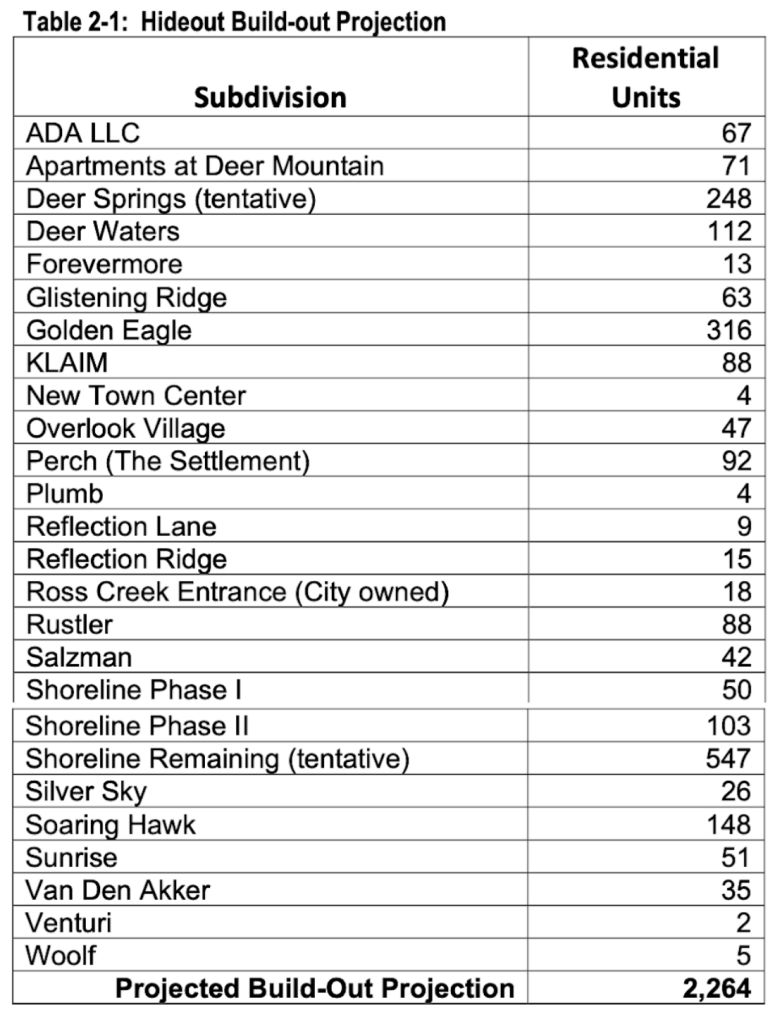
However, several of these subdivisions brought their own water rights: KLAIM, Deer Springs and Deer waters, leaving a balance of 1,816 units. If Hideout changes its water standards and lowers it to 0.45 as the state allows, that means it will need between 800 and 1,300 acre feet of water to serve a full build out of the Town depending on the mix of the homes to be built (a large home over 3,000 square feet requires more water than a condo).
Under the current agreement with JSSD, the town has rights for 300 acre feet of water, 150 acre feet of culinary water and 150 acre feet of reserves.
Which leaves an estimated 500 and 1,000 acre feet of future deficit, a fiscal bomb of $13 million and $25 million dollars which could have been forced on Mustang when the subdivisions were approved, but now no longer can.
When the Comment asked Ms. McCosh whether the inflated water rates were to pay for the Town’s water shares deficit, McCosh replied with “no comment.”
Lingering open questions
The lack of transparency by the administration leaves many questions unanswered. While we speculate the magnitude of the fiscal bomb, much of the legal analysis done for the Town remains out of the public eye, and so is any analysis of the actual deficit and the ways to remedy it.
Most of all, who will pay for the missing rights? Landowners who believed their development was approved with water rights? Existing residents? The Town’s insurance company?
We will follow up with answers as soon as the administration provides those.
 The Hideout Comment